
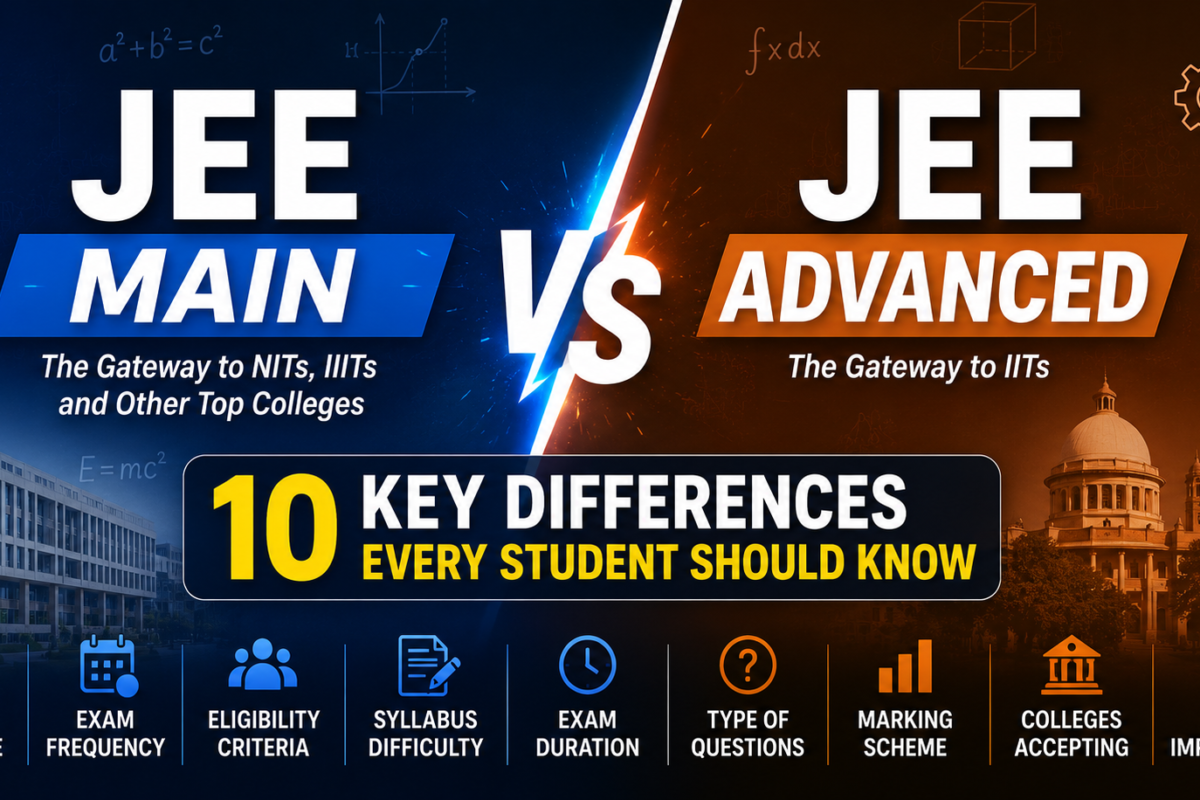
JEE Main vs JEE Advanced: 10 Key, If you’re planning to become an engineer, you’ve probably heard about JEE Main and JEE Advanced. These two exams are the gateway to some of India’s top engineering colleges. But many students, especially those starting Class 11, often get confused. Are they the same exam? Which one is harder? Can you appear for JEE Advanced without clearing JEE Main? These are common questions, and honestly, it’s normal to have them. Understanding the difference between JEE Main and JEE Advanced is important because your preparation strategy depends on it. Both exams test your knowledge of Physics, Chemistry, and Mathematics, but they are designed for different purposes and have different levels of difficulty. In this guide, we’ll break down the 10 key differences between JEE Main vs JEE Advanced in simple language. By the end, you’ll know which exam leads to which college, how the patterns differ, and how you should prepare for each one.
What Is JEE Main?
JEE Main is a national-level engineering entrance exam conducted by the National Testing Agency (NTA). It is the first stage of the IIT JEE admission process. Students who perform well in JEE Main become eligible for two things:
- Admission to NITs, IIITs, and other government-funded engineering colleges.
- Qualification for JEE Advanced.
Every year, lakhs of students appear for JEE Main because it opens the door to many excellent engineering colleges across India.
The exam focuses on:
- Physics
- Chemistry
- Mathematics
Apart from engineering admissions, your JEE Main score is also accepted by many private universities.
What Is JEE Advanced?
JEE Advanced is the second stage of the IIT admission process. Only students who qualify in JEE Main can appear for this exam. This exam is conducted by one of the IITs every year under the guidance of the Joint Admission Board (JAB). The main purpose of JEE Advanced is to select students for admission into the Indian Institutes of Technology (IITs). The questions are more challenging than JEE Main. Instead of testing only formulas and concepts, JEE Advanced checks how well you can apply those concepts to solve complex problems. That’s why many students consider it one of the toughest entrance exams in India.
Why Do Students Get Confused Between JEE Main and JEE Advanced?
At first glance, both exams look similar. Both cover PCM subjects. Both are entrance exams. Both are related to IIT. But once you start preparing, the differences become clear.
For example:
- JEE Main is mainly about speed and accuracy.
- JEE Advanced focuses more on analytical thinking and deep conceptual understanding.
Knowing this difference early can help you avoid common preparation mistakes.
JEE Main vs JEE Advanced: Quick Comparison
| Feature | JEE Main | JEE Advanced |
|---|---|---|
| Conducting Body | National Testing Agency (NTA) | One of the IITs under JAB |
| Purpose | Admission to NITs, IIITs, and qualifying for JEE Advanced | Admission to IITs |
| Difficulty Level | Moderate to High | High |
| Eligibility | Class 12 students | Qualified JEE Main candidates only |
| Competition | Very High | Extremely High |
This table gives you a quick overview, but there’s much more to understand.
Let’s look at the first five major differences.
1. Purpose of the Exam
This is the biggest difference. JEE Main is the qualifying exam. JEE Advanced is the selection exam. A good JEE Main score can get you into top NITs, IIITs, and many centrally funded technical institutions. If your dream is to study at an IIT, clearing JEE Main alone isn’t enough. You must also qualify for and perform well in JEE Advanced.
2. Eligibility Criteria
Anyone who meets the eligibility requirements can appear for JEE Main. JEE Advanced has an extra step. Only the top-performing candidates in JEE Main are allowed to appear. This means every JEE Advanced candidate has already cleared one competitive exam before reaching the second stage. That naturally makes the competition much tougher.
3. Difficulty Level
Let’s be honest. This is what most students want to know. JEE Main tests your understanding of concepts and your ability to solve questions quickly. JEE Advanced goes several steps further. Questions often combine multiple concepts into a single problem. Sometimes there isn’t an obvious approach. You’ll need strong logical thinking, patience, and consistent practice. That’s why students preparing for IIT usually spend more time solving advanced-level questions after building their basics.
4. Number of Candidates
Every year, more than a million students register for JEE Main. Only a small percentage qualify for JEE Advanced. By the time students reach the Advanced stage, they’re competing with some of the strongest aspirants in the country. That changes the level of competition completely.
5. Admission Opportunities
A good JEE Main rank opens the doors to:
- National Institutes of Technology (NITs)
- Indian Institutes of Information Technology (IIITs)
- Government-funded engineering colleges
- Many private universities
JEE Advanced is specifically for admission into the IITs. These institutes are known for their academic excellence, research opportunities, and strong placement records. Choosing the right preparation strategy depends on your goal. If your target is an NIT, your study plan may look different. If your goal is an IIT, you’ll need to prepare for both exams from the beginning. Many students preparing under experienced mentors at the best IIT JEE classes in Nagpur begin building strong fundamentals in Class 11 itself. That gives them enough time to prepare for both JEE Main and JEE Advanced without feeling rushed. In the next section, we’ll look at the remaining five differences, including the exam pattern, question style, marking scheme, preparation strategy, and which exam is more difficult to crack. We’ve already covered the first five differences. Now let’s look at the remaining ones. These differences directly affect how you prepare, practice, and manage your time during the exam.
6. Exam Pattern
One of the biggest differences between JEE Main vs JEE Advanced is the exam pattern.
JEE Main
The exam pattern is quite predictable.
Students know:
- Number of questions
- Subjects
- Marking scheme
- Time duration
This makes preparation a little easier because you know what to expect.
JEE Advanced
JEE Advanced is different. The exam pattern can change every year.
Some years have:
- Multiple correct answers
- Integer-type questions
- Numerical value questions
- Paragraph-based questions
- Matrix matching questions
This unpredictability is one reason students find JEE Advanced more challenging.
7. Question Style
JEE Main focuses on speed and accuracy. Most questions test whether you understand the concept and can apply it quickly. For example, a Physics question may ask you to calculate the final answer using one or two formulas. JEE Advanced often combines multiple concepts into one problem.
A single question may require:
- Conceptual understanding
- Logical reasoning
- Mathematical calculations
- Analytical thinking
Sometimes you’ll spend five or six minutes solving just one question. That’s completely normal.
8. Marking Scheme
The marking system is another major difference.
JEE Main
The marking scheme usually remains simple.
- Correct answer: +4 marks
- Incorrect answer: -1 mark
- Numerical questions generally have no negative marking.
Students can plan their attempts with confidence.
JEE Advanced
The marking scheme changes almost every year.
Some questions include:
- Partial marking
- Negative marking
- Multiple correct answers
- No negative marking
- Different marks for different question types
Because of this, reading the instructions carefully becomes just as important as solving the questions. Many students lose marks simply because they assume the marking scheme is the same as JEE Main.
9. Preparation Strategy
This is where many students make mistakes. They prepare for JEE Main and expect the same preparation to work for JEE Advanced. It usually doesn’t.
For JEE Main
Focus on:
- NCERT textbooks
- Strong fundamentals
- Formula revision
- Previous year papers
- Mock tests
- Time management
For JEE Advanced
You’ll need extra practice.
Focus on:
- Advanced-level books
- Multi-concept questions
- Problem-solving skills
- Analytical thinking
- Regular revision
- Full-length mock tests
Students targeting IITs usually begin Advanced-level practice after completing their basic concepts.
10. Competition Level
Both exams are competitive. But the competition isn’t the same. In JEE Main, you’re competing with lakhs of students from across the country. In JEE Advanced, you’re competing with students who have already cleared JEE Main with good scores. That naturally increases the competition. Everyone has strong basics. Small mistakes can make a huge difference in your rank.
JEE Main vs JEE Advanced Comparison Table
| Feature | JEE Main | JEE Advanced |
|---|---|---|
| Purpose | NITs, IIITs & Qualification | Admission to IITs |
| Difficulty | Moderate to High | High |
| Conducting Body | NTA | IIT under JAB |
| Exam Pattern | Mostly fixed | Changes every year |
| Question Style | Direct & Concept Based | Analytical & Multi-Concept |
| Marking Scheme | Predictable | Varies every year |
| Competition | Very High | Extremely High |
| Preparation | NCERT + Practice | Advanced Concepts + Practice |
| Admission | NITs, IIITs, GFTIs | IITs |
| Level of Thinking | Conceptual | Deep Analytical |
Which Exam Is Harder?
If someone asks, “Which exam is tougher?” The answer is quite clear. JEE Advanced. But that doesn’t mean JEE Main is easy. Scoring a high percentile in JEE Main also requires months of consistent preparation. The real difference lies in the type of questions. JEE Main assesses whether you understand the concepts. JEE Advanced checks whether you truly understand the concept and can apply it in different situations. That’s why many students say JEE Advanced feels more like a test of thinking than memorisation.
Can You Prepare for Both Together?
Yes. In fact, that’s the smartest approach. Most students don’t prepare separately. They build strong concepts first. Then they move toward advanced-level questions. If you’re preparing from Class 11, you have enough time to cover both exams comfortably.
A balanced study plan usually includes:
- NCERT study
- Reference books
- Daily problem solving
- Weekly mock tests
- Monthly revision
Preparing this way helps you stay ready for both JEE Main and JEE Advanced. Many experienced teachers at the best IIT JEE classes in Nagpur follow this method because it keeps students on track without creating unnecessary pressure.
Common Mistakes Students Make
Some mistakes appear every year.
Try to avoid them.
- Studying only theory
- Ignoring NCERT
- Skipping mock tests
- Solving very difficult questions too early
- Not analysing mistakes
- Avoiding revision
- Comparing your progress with others
Focus on your own preparation. Steady improvement matters much more than quick results.
Which Exam Should You Focus On?
If your goal is an IIT, prepare for both exams from the beginning. Strong preparation for JEE Advanced automatically strengthens your JEE Main preparation as well. If your target is an NIT or IIIT, you can concentrate more on JEE Main while still building solid concepts. Either way, consistency is more important than studying for long hours once in a while.
Subject-Wise Preparation Strategy for JEE Main and JEE Advanced
No matter which exam you’re targeting, one thing stays the same. You need strong fundamentals. Trying to memorise shortcuts without understanding the basics usually doesn’t work, especially in JEE Advanced. Let’s look at a practical strategy for each subject.
Physics
Physics is all about concepts and practice. Many students understand the theory but struggle with numerical problems.
Here’s what you should do:
- Study one chapter at a time.
- Understand the concepts before solving questions.
- Practice numerical problems every day.
- Revise formulas regularly.
- Solve previous year questions after completing each chapter.
Topics like Mechanics, Electricity, Modern Physics, and Thermodynamics deserve extra attention because they carry significant weight.
Chemistry
Chemistry has three parts, and each one needs a different approach.
Physical Chemistry
- Focus on concepts.
- Practice numerical questions daily.
- Revise formulas often.
Organic Chemistry
- Understand reaction mechanisms.
- Don’t try to memorise every reaction without understanding it.
- Practice conversion-based questions.
Inorganic Chemistry
- Read NCERT thoroughly.
- Make short notes.
- Revise regularly because many facts are easy to forget.
Mathematics
Maths improves with consistent practice. There’s no shortcut. Try solving different types of problems instead of repeating the same pattern.
Focus more on:
- Calculus
- Algebra
- Coordinate Geometry
- Vectors and 3D Geometry
Time yourself while solving questions. It helps improve speed and accuracy.
Smart Tips to Crack Both Exams
A few simple habits can make a big difference.
- Create a realistic study timetable.
- Study every day instead of only on weekends.
- Revise each topic at least once every week.
- Solve previous year papers regularly.
- Attempt full-length mock tests.
- Review every mistake after each test.
- Maintain short notes for quick revision.
- Take short breaks to avoid burnout.
Progress doesn’t happen overnight. Small improvements every day build confidence over time.
Why Mock Tests Are So Important
Many students avoid mock tests because they’re afraid of getting low scores. That’s completely normal. But mock tests are one of the best learning tools.
They help you:
- Improve time management.
- Identify weak topics.
- Build exam confidence.
- Reduce silly mistakes.
- Understand the actual exam pattern.
Don’t worry too much about your first few scores. Focus on learning from them. That’s where real improvement happens.
Why Trustworthy Study Guidance Matters
When searching for JEE preparation tips online, you’ll find thousands of articles. Not all of them are equally useful. Good guidance comes from people with real teaching experience, accurate information, and a genuine understanding of the exam. That’s exactly what Google’s EEAT principles encourage.
Experience
Learn from teachers and mentors who have guided students through JEE preparation.
Expertise
Follow study methods that are based on the latest exam pattern and syllabus.
Authoritativeness
Choose trusted coaching institutes, official exam resources, and reliable study materials.
Trustworthiness
Verify important information through official sources like the National Testing Agency (NTA) and the Joint Admission Board (JAB). Building your preparation on reliable information helps you stay focused and avoid unnecessary confusion.
Frequently Asked Questions
Is JEE Advanced compulsory after JEE Main?
No.
If you want admission to an IIT, you must qualify for and appear in JEE Advanced. If you’re aiming for NITs, IIITs, or many other engineering colleges, JEE Main is enough.
Can I prepare for JEE Main and JEE Advanced together?
Yes.
In fact, most successful aspirants prepare for both exams at the same time. Start with strong concepts and gradually move toward advanced-level questions.
Which exam is more difficult?
JEE Advanced is generally considered more difficult because the questions test deeper conceptual understanding and analytical thinking.
Is NCERT enough for JEE Main?
NCERT is very important, especially for Chemistry. For Physics and Mathematics, you should also practice from good reference books and previous year question papers.
How many hours should I study every day?
There’s no fixed number. Many successful students focus on consistent, productive study rather than counting hours. Quality matters more than quantity.
Final Thoughts
Understanding the difference between JEE Main vs JEE Advanced helps you prepare with the right mindset. JEE Main checks your speed, accuracy, and understanding of concepts. JEE Advanced pushes you further by testing how well you can apply those concepts to solve challenging problems.
Instead of treating them as two completely separate exams, build a strong foundation from the beginning. Strengthen your concepts, practice regularly, revise consistently, and learn from every mock test. If you’re aiming for an IIT, starting your preparation early can give you a real advantage. Guidance from experienced teachers, a structured study plan, and regular doubt-solving sessions can make your journey much smoother. Students looking for the best IIT JEE classes in Nagpur should choose a coaching institute that focuses on concept clarity, regular assessments, and individual attention rather than just completing the syllabus. Stay curious. Keep practising.
Every chapter you complete and every question you solve brings you one step closer to your engineering dream. Consistent effort, patience, and the right preparation strategy can help you perform well in both JEE Main and JEE Advanced.

